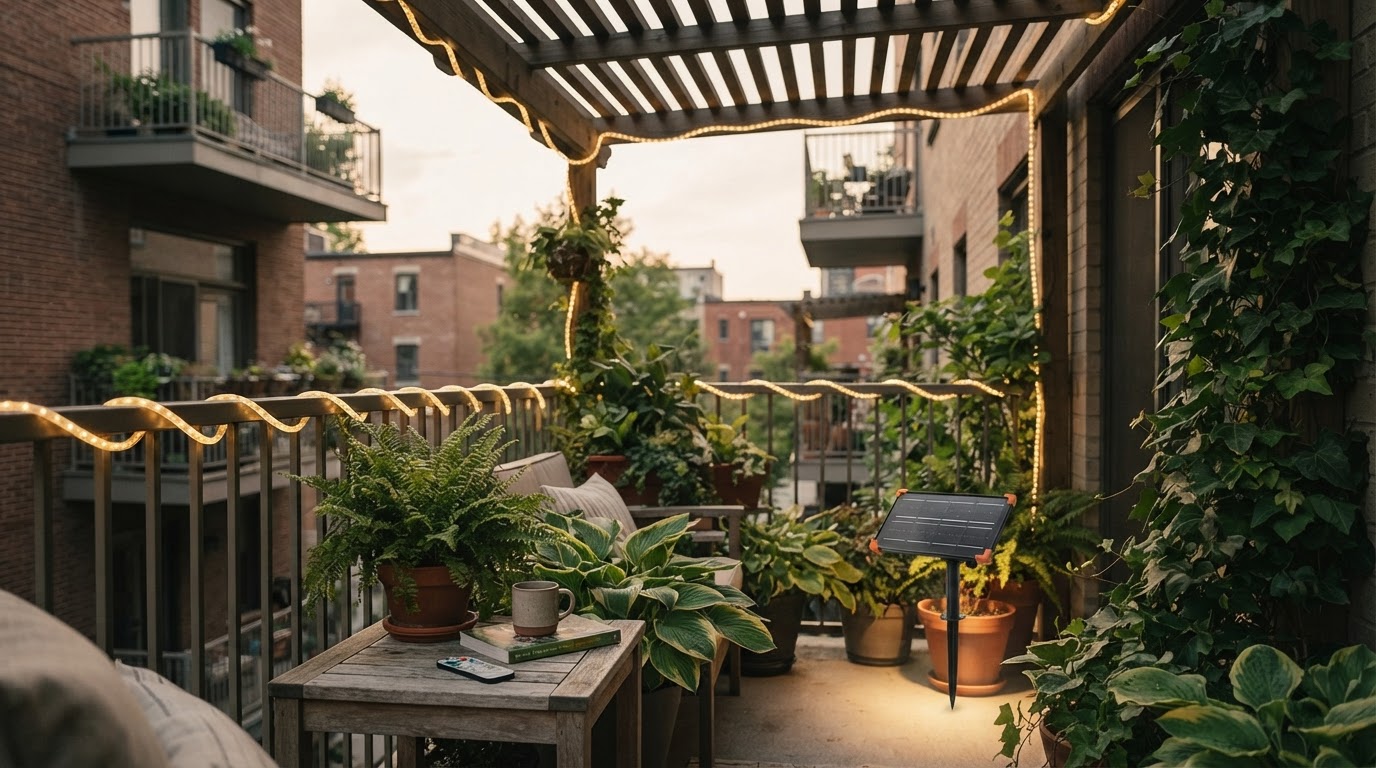
Can Solar LED Strip Lights Charge on Shaded Balconies?
 Priya RamanSenior Analyst
September 17, 2026 — Solar LED Strip Lights can successfully charge on shaded balconies, though their operational efficiency and run-time are reduced compared to installations receiving direct solar exposure.
For apartment dwellers and urban homeowners, the viability of solar technology often hinges on the specific geometry of their outdoor space. This inquiry typically arises when a north-facing unit or a structural overhang limits the duration of peak solar radiation. Understanding the feasibility of these systems requires a framework that moves beyond a binary "yes or no" and instead analyzes the relationship between ambient light levels and battery saturation.
Think of it as a matrix of light quality versus hardware placement. Two axes matter here: the intensity of the lux (lumens per square meter) reaching the balcony and the positioning of the photovoltaic panel relative to the structure's shadow line. By mapping these variables, users can predict whether their waterproof solar powered rope lights will provide four hours of illumination or eight.
How do Solar LED Strip Lights function without direct sun?
Solar LED Strip Lights function in the shade by capturing the diffuse radiation present in daylight, even when the sun is obstructed by clouds or architectural barriers. According to Inlux Solar, while solar lights function in shaded areas, their charging capacity decreases significantly when compared to direct sunlight conditions. The photovoltaic cells utilize the visible light spectrum to generate a current, albeit at a lower amperage.
The decision rule: If the balcony receives clear daylight for at least six hours, the system will likely store enough energy for evening ambiance, even if the panel never sees a direct sunbeam. However, performance is not uniform across all shaded environments. A deeply recessed balcony with high walls acts as a light trap, whereas a balcony with glass railings allows for greater reflection of ambient photons. Data from Quora contributors suggests that while the lights will activate, the battery might only achieve a partial charge, leading to a noticeable dimming or shorter run-time as the night progresses. Users should prioritize panels with higher conversion efficiencies to maximize the limited photon intake available in these sub-optimal zones.
Can positioning overcome balcony shade limitations?
Strategic positioning can mitigate the effects of structural shade by placing the solar collector at the outermost edge of the balcony where light intensity is highest. As noted in discussions on the Kakirepair community forum, users often find success by utilizing lights with long connector cables that allow the LED strips to remain in the shade while the panel is mounted in a sunnier peripheral area. Once you see it this way, the balcony becomes a zoned environment where the decorative element and the power source occupy different light-quality tiers.
For those dealing with permanent shadows from neighboring buildings, the angle of the panel becomes the primary lever for optimization. Tilting the panel toward the open sky rather than vertically against a wall can increase the surface area exposed to descending ambient light. This technique is particularly useful for renter-friendly solar balcony light hacks where permanent mounting isn't an option. By treating the solar panel as a mobile collector, residents can adjust the placement seasonally as the sun's path across the sky changes, ensuring the Solar LED Strip Lights maintain a consistent discharge cycle throughout the year.
Quick answers
Q: Do solar lights need heat from the sun to charge? / A: No, solar panels convert light, not heat, into electricity. Solar LED Strip Lights will charge in cold, shaded conditions as long as there is visible daylight reaching the photovoltaic surface.
Q: How many hours will the lights stay on if they are in total shade? / A: In total shade with no direct sun, most high-quality strips will provide 2 to 4 hours of light. This is significantly less than the 8 to 12 hours achieved after a full day of direct solar exposure.
Q: Can I charge a solar panel through a glass balcony door? / A: While possible, glass reflects and absorbs a portion of the light spectrum, reducing charging efficiency by roughly 30% to 50%. It is always recommended to place the panel on the exterior side of the glass for peak performance.
For further details on maximizing your setup, see our guides on /blog/enhancing-small-balconies-with-solar-led-strip-lights and /blog/renter-friendly-solar-balcony-light-hacks.
Learn more about Solar LED Strip Lights at https://solarledstrip.com.
Sources
- Will Solar Lights Charge in the Shade? Your Comprehensive Guide
- Will solar lights work in a shady garden with trees? - Facebook
- Frequently Asked Questions about Shade Solar